
From the Airwaves to the Grid: A Conversation on Property Rights and Power in Arkansas
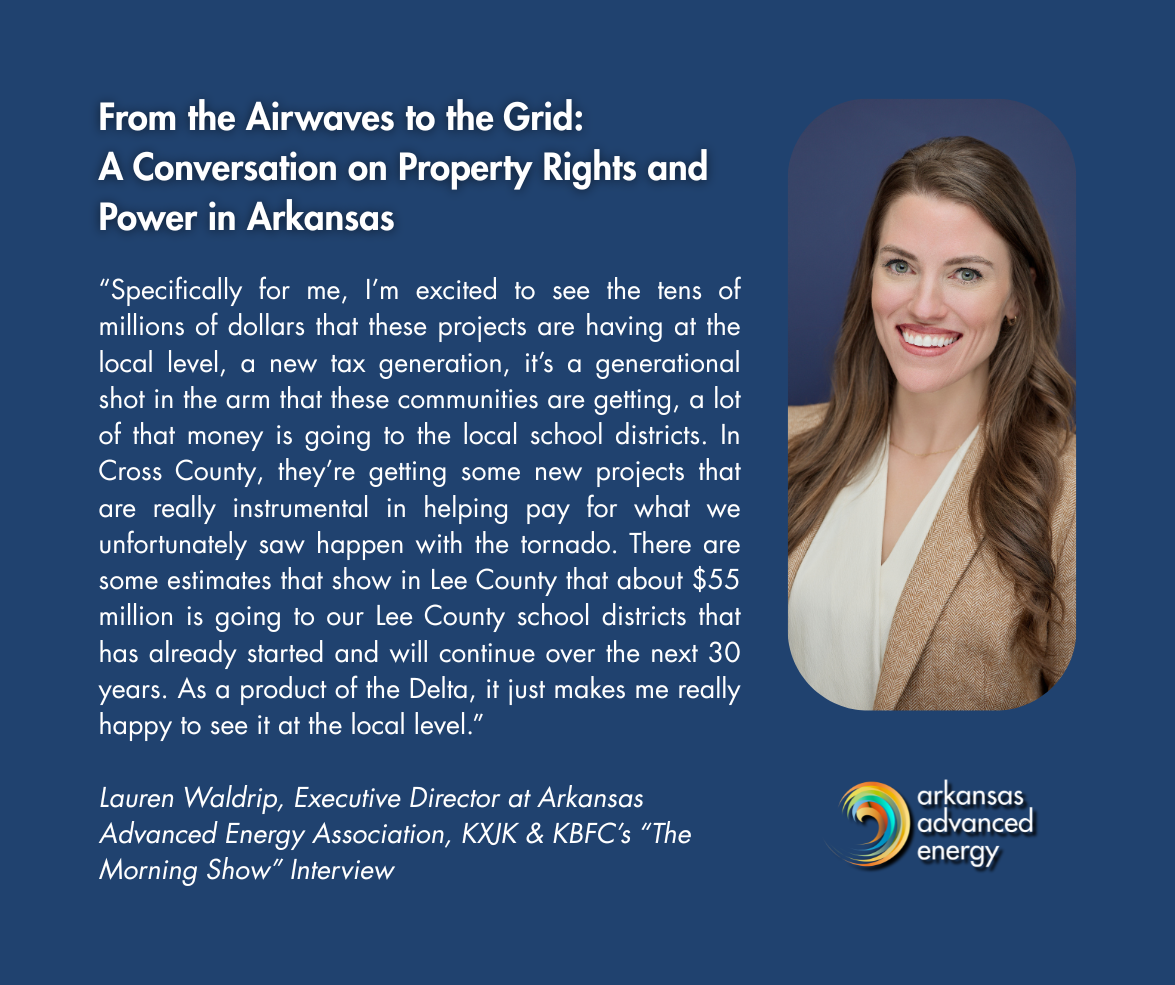
Lauren Waldrip, Executive Director of Arkansas Advanced Energy Association, recently visited with Richard on KXJK & KBFC’s “The Morning Show” to talk about property rights, the benefits of solar development for landowners and Arkansas’s energy shortage. Below are highlights from the interview, or click the audio player above to listen to the full interview.
A lot of the farmers that I respect were getting into solar panels, and I wondered, I began to realize firsthand the economic benefits that could have to help insulate them from an otherwise rising energy cost. A lot of the principles that I believe in conservatively - free market, pro competition, property rights - we help push for energy independence and national security through more energy generation and pushing down lower costs. Renewables happen to be a part of that conversation, they are definitely not the whole piece of the puzzle, but we know that coal is not the cheapest anymore, we know these data centers are coming online, and we need more power just as soon as we can get it. Renewables happen to be the quickest to market. But specifically for me, I’m excited to see the tens of millions of dollars that these projects are having at the local level, a new tax generation, it’s a generational shot in the arm that these communities are getting, a lot of that money is going to the local school districts. In Cross County, they’re getting some new projects that are really instrumental in helping pay for what we unfortunately saw happen with the tornado. There are some estimates that show in Lee County that about $55 million is going to our Lee County school districts that has already started and will continue over the next 30 years. As a product of the Delta, it just makes me really happy to see it at the local level.
We’re actually now starting to see battery storage become more affordable. With the lithium play that’s down in the southwest corner of the state, we’ve started getting more of those members, and we’re interested in that for two reasons, one because of the economic impact it can have in that corner of the state and the state as a whole really, but two because we know battery storage is going to have to play a role in all the different gaps we have with the grid. We know that agriculture, at the end of the day, is our state’s largest industry and, unfortunately, forecasts show 1 in 3 Arkansas farmers are going to have to file bankruptcy this year. So we’ve also seen where these projects can be an additional revenue stream for them. The University of Arkansas has put out studies that show that the land use from an energy standpoint can be a good thing; we’re not in a food crisis, we’re in an energy crisis. It gives landowners and farmers another option for what they can do to make ends meet.
At the end of the day, more energy on the grid means more affordable energy.
If farmers want to generate their own power to offset their own costs rather than just renting out their land, that’s how I really got started into this; unfortunately the legislators overturned that, some of the utilities were pushing for that to not be a viable option unfortunately for our farmers anymore, so we don’t see quite as much of that. Hopefully in the future, our friends at the utilities have told us, they don’t have enough power to avoid the deficit. SWEPCO, for example, has projected a deficit starting this year, Entergy’s will start in 2028, they have some coal plants coming off line. I don’t make the rules but we’ve known these coal plants would be coming off line for a while, so we have a lot of folks who are asking more questions about other energy generation opportunities in light of that. And we know there’s going to be a shortfall, we know that’s going to lead to higher energy costs. So hopefully the legislature will revisit that soon. I’m a free market competition kind of person, we want our farmers to be able to generate their own power in a way that we know is not shifting costs on to other customers.
Our utilities have what’s called an integrated resource planning process and they do that once every three years, obviously some of these projects take longer than three years to get planned and built and connected, when I first went through that process two January’s ago, and they put up their projections with the deficit coming soon, I said forget my job, as someone who is expecting a child soon, and just as a ratepayer, this is very concerning to me, surely someone above my pay grade is paying attention to this. It is confusing, right? We have known these coal plants are coming off line for a long time and we know the later we plan to put these resources online, the more it’s going to cost our ratepayers. Our group is very active not just at the legislature but at our regulators and public service commission, and unfortunately there is a record-breaking number of rate cases on the table at the public service commission, that means they’re trying to raise rates. And it’s no surprise, we know energy prices are going up just to keep up with inflation, that’s not surprising or unexpected. But SWEPCO, for example, just raised rates 23 percent and they’ve had three rate cases in the past six years; they’re supposed to have one every five. We just have to really look at the way we plan for this very differently, we can’t just continue to do it the way we’ve always done it. We have to consider new technology, new policies, new concepts cross the board. It’s going to be a whole host and suite of options - it’s going to be some energy efficiency, some demand response programs and robust management of what we have behind-the-meter, and that’s not what we have right now.
We’ve never had some of the brownouts and blackouts like they’re seeing in Louisiana, for example, just because they have a shortage of power. Yes, Arkansas does have some of the most affordable power in the nation, and that’s great for economic development and recruitment of new business to our state, but if we don’t have the power to sell, then that doesn’t do us a whole lot of good. And we certainly want to take care of our current residents and businesses that are here as it is. Google is another one of our members that wants to make sure this is done responsibly so they’re invested in community benefits, have specifically pushed for the energy that’s going to generate their power for that to be renewables. That’s not me talking, that’s what market forces are pushing for. At the end of the day, we need as many electrons on the grid as we can get. There’s a new wind development over in Cross County; the legislature was very clear this year, that we need as much energy as we can get on the grid. Unfortunately, they then passed a bill that would prohibit some of those new projects and economic development and tax dollars to counties and school districts, and took away that local control. Hopefully they’ll revisit that and we’ll get something on the books soon.
It’s interesting right? As a conservative, I’m a firm believer in property rights. We saw the legislature do some things that was counter to that. And we actually had some local chambers of commerce or different counties very interested in those economic development, jumping up and down to get those projects, and then you have the state coming in and stripping away local control, and then they’re call us and say you know, this is a generational shot in the arm and an opportunity economically we’re never going to see again, and we’d really like to have it. We have some landowners that have gotten upset about that too; unfortunately, there have been lawsuits with entities not allowing them to do what they want with their land, and it can be contested. But at the end of the day when you talk about energy independence and national security, those are things we can all agree on so hopefully we can all get together on the same page when it comes to taking care of our ratepayers and pushing for low-cost, affordable and reliable energy.